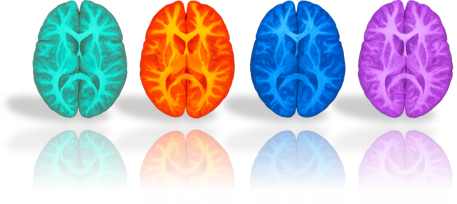
Tract-Based Spatial Statistics (TBSS)
Diffusion MRI
Our Diffusion Tensor Metrics analysis quantifies the microstructural properties of white matter at the voxel level. By modeling the anisotropic diffusion of water molecules, this approach captures subtle variations in axonal density, myelination, and fiber organization. These metrics are widely used to study brain development, aging, and neurodegenerative disorders.
Supported methods include:
- Preprocessing
- Fractional Anisotropy (FA)
- Mean Diffusivity (MD)
- Axial/Radial Diffusivity (AD/RD)
- Voxel-Wise Statistical Mapping
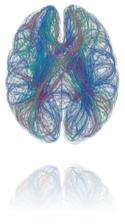
Tractography Analysis
Diffusion MRI
Our Tractography pipeline reconstructs three-dimensional fiber pathways in the brain, providing a detailed visualization and quantification of structural connectivity. Both deterministic and probabilistic algorithms are supported, allowing comprehensive mapping of major fiber bundles and complex crossing fibers.
Supported methods include:
- Whole-Brain Tractography
- ROI-Based Tract Reconstruction
- Quantitative Tract Metrics
- Visualization Tools
- Integration with Network Analysis
Advanced Diffusion Imaging (HARDI, CSD, DSI)
Diffusion MRI
Our Advanced Diffusion Imaging framework extends standard DTI to capture complex white matter architecture in regions with crossing or kissing fibers. These high-angular resolution methods provide more accurate reconstruction of fiber orientation and connectivity compared to classical DTI.
- HARDI (High Angular Resolution Diffusion Imaging)
- Constrained Spherical Deconvolution (CSD)
- Diffusion Spectrum Imaging (DSI)