Functional Brain Data Analysis
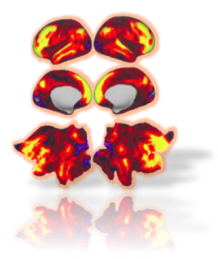
Functional and Resting-State Connectivity
Functional MRI
Our team integrates both task-based and resting-state fMRI data to map the full spectrum of functional brain organization—from transient activation patterns to stable connectivity networks. This dual approach allows for comprehensive assessment of how external stimuli and intrinsic activity jointly shape cortical dynamics. We employ multimodal modeling frameworks to align activation clusters with underlying resting-state networks, enabling robust cross-condition comparisons and multimodal interpretation.
Supported methods include:
- Preprocessing
- General Linear Model (GLM)
- Joint GLM–Connectivity Modeling
- Psychophysiological Interaction (PPI)
- Independent Component Analysis (ICA)
- Functional Connectivity Analysis
- Multimodal Visualization.
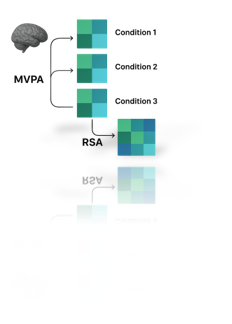
Multivariate Pattern fMRI Analysis
Functional MRI
Our Multivariate Pattern Analysis (MVPA) framework provides an advanced multivariate modeling approach to decode distributed neural information across voxels, regions, or networks. Unlike classical univariate methods, MVPA captures spatially correlated activation patterns that jointly represent perceptual, cognitive, or clinical states. This analysis allows for both discriminative decoding and representational modeling, offering a bridge between brain activity patterns, computational models, and behavior. We integrate complementary approaches — including Representational Similarity Analysis (RSA), Distance Correlation (dCor), Singular Value Decomposition (SVD), Representational Component Analysis (RCA), and Multivariate Pattern Dependence (MVPD) — to provide a full-spectrum characterization of neural representational structure and inter-regional dependencies.
Supported methods include:
- Representational Similarity Analysis (RSA)
- Distance Correlation (dCor)
- Singular Value Decomposition (SVD)
- Representational Component Analysis (RCA)
- Multivariate Pattern Dependence (MVPD)
- Searchlight and ROI-based Implementation
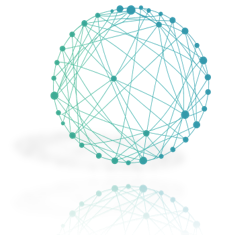
Network Analysis and Graph Theory Metrics
Functional MRI
Our Brain Network and Graph-Theoretical Analysis service characterizes the brain as a complex, interconnected network, using advanced mathematical models to quantify topology and organization. This approach transforms voxel- or ROI-level time series into a graph representation, allowing precise evaluation of how efficiently different brain regions exchange information. It supports both static and dynamic modeling for deep insight into network efficiency and resilience.
Supported methods include:
- Correlation and Partial Correlation Networks
- Graph-Theoretical Indices
- Network-Based Statistics (NBS)
- Community Detection Algorithms
- Visualization Tools
- Dynamic Connectivity
- Network Coherence Metrics
- Graph-Theoretical Metrics.
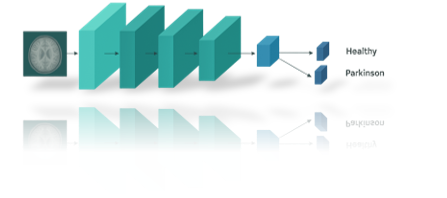
Machine Learning and Deep Learning fMRI Modeling
Functional MRI
Our Machine Learning and Deep Learning Analysis framework leverages modern computational models to capture complex, nonlinear relationships within large-scale fMRI datasets. These data-driven methods enable predictive modeling of behavioral outcomes, clinical diagnosis, and cognitive states from multivariate brain signals. By combining high-dimensional feature extraction with supervised and unsupervised algorithms, we uncover latent representations that traditional statistical models often miss.
- Classical Machine Learning models
- Deep Learning Architectures
- Autoencoders and Variational Models
- Cross-Modal Prediction